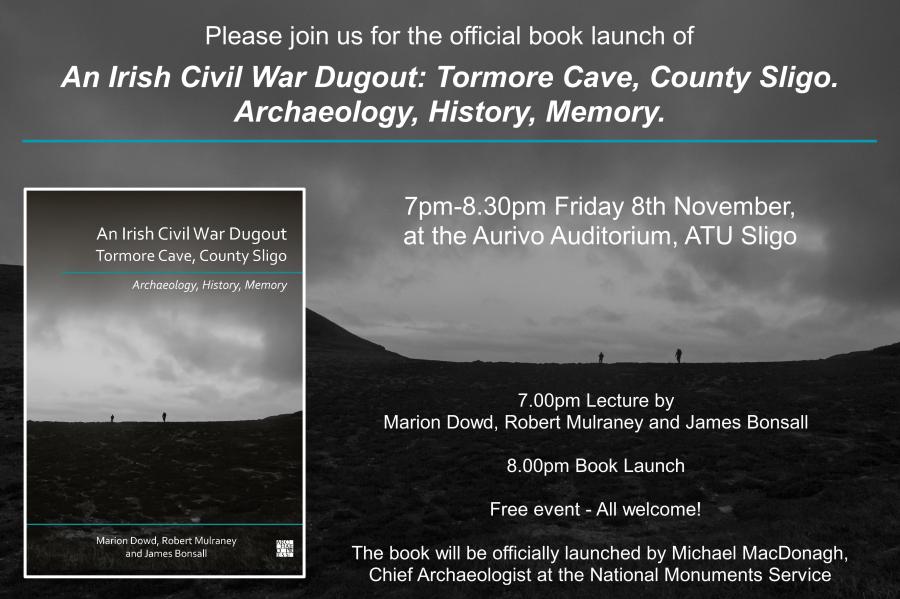
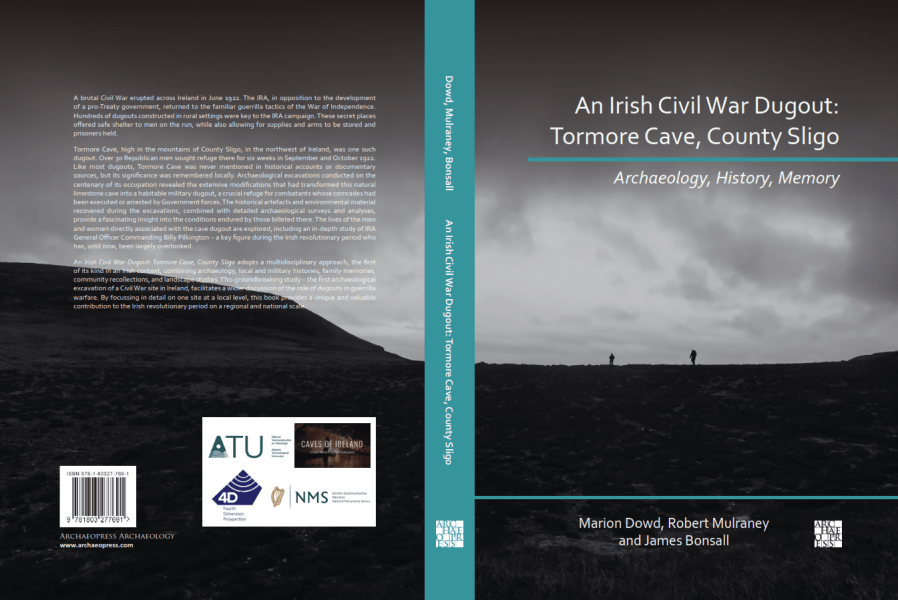
The Tormore Cave Project which, in 2022 saw the release of our book, The Six, is proud to announce the culmination of our efforts, An Irish Civil War Dugout: Tormore Cave, County Sligo – Archaeology, History, Memory. Co-authored by Marion Dowd, Robert Mulraney, and James Bonsall, the book will be launched at ATU Sligo, 8th November 2024. All welcome.
It is almost three years to date when we first visited Tormore Cave, on the back of cherished family memories of the site. It is more than 70 years since Father William Pilkington last visited the cave which had a profound influence on his life. It is also 102 years since Pilkington, as General Officer Commanding of the 3rd Western Division IRA, sought refuge there, along with more than 30 men, for six weeks.
Their retreat was a desperate one in which the new, confident, and uncompromising Free State National Army drove the last stand of Sligo Republicans into the hills and plains of the Dartry mountains. In doing so, they isolated six republicans, likely making their way to the cave hideout, on the slopes of Benbulbin. The men were disarmed and, defenceless, were cut to shreds with Lewis machine gun fire (‘The Six‘). Thirty other Republicans escaped into Tormore Cave, a dugout prepared for the most desperate of events – like those which occurred on September 20th, 1922.
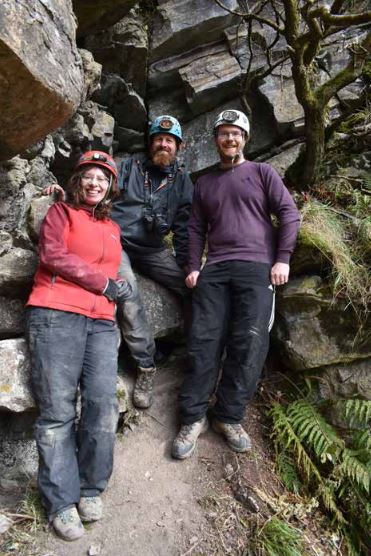
When we – three archaeologists – arrived in late 2021, little was known about the cave, save that retained in local and familial memory. Six months later we conducted a cave excavation (under license of Dr. Marion Dowd, co-author). Two further years later, combining primary and secondary sources as diverse as lithic analysis, zooarchaeology, geological consultancy, military and media archives – published and unpublished, interviews with family descendants and untranscribed diaries and recordings, we can now present a most exhaustive analysis of these otherwise forgotten events.
Our work in its final form is unique – a detailed analysis of what some historians might consider a ‘non-event’, that is, a brief period of reclusive silence at the periphery of the main events of civil war. The protagonists of the story, men and women who were generally not to be remembered, are at the fore. A further man, Fr. William Pilkington, who played a vital role, nationally, at the close of the Civil War, would have been remembered were it not for his intentional self-removal from the story. His first biography is given here. Another unique aspect and a first, is the cave excavation itself – the first Civil War site and, dugout site, to be excavated in Ireland.
There are many strands to this book and it is made for a multitude of interests. Reflecting this, and the fact that we are ultimately at the debt of the community who safeguarded their story, and allowed us to tell it, the publication will be available to freely download, upon the book’s launch.
 Caves Of Ireland