Tormore Cave book launch

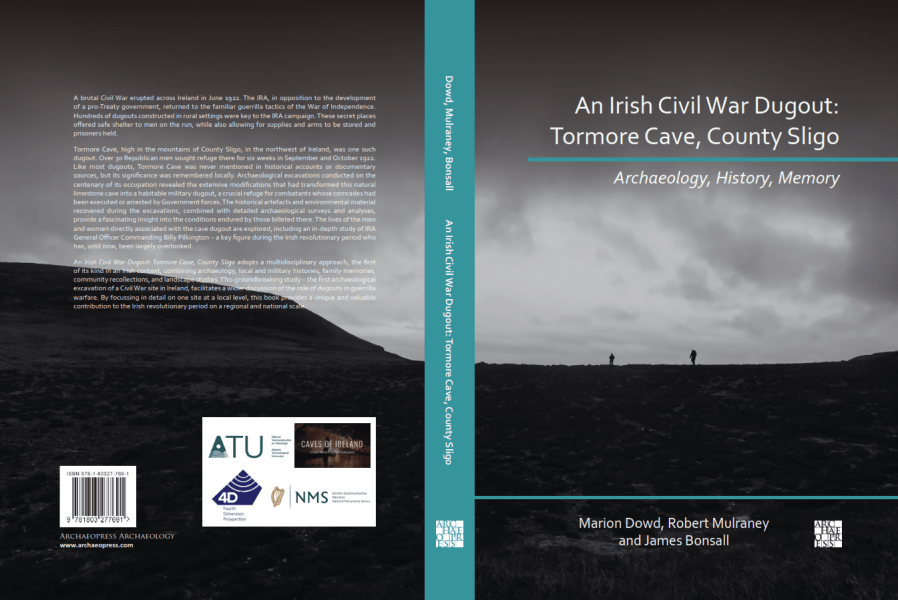
The Tormore Cave Project which, in 2022 saw the release of our book, The Six, is proud to announce the culmination of our efforts, An Irish Civil War Dugout: Tormore Cave, County Sligo – Archaeology, History, Memory. Co-authored by Marion Dowd, Robert Mulraney, and James Bonsall, the book will be launched at ATU Sligo, 8th November 2024. All welcome.
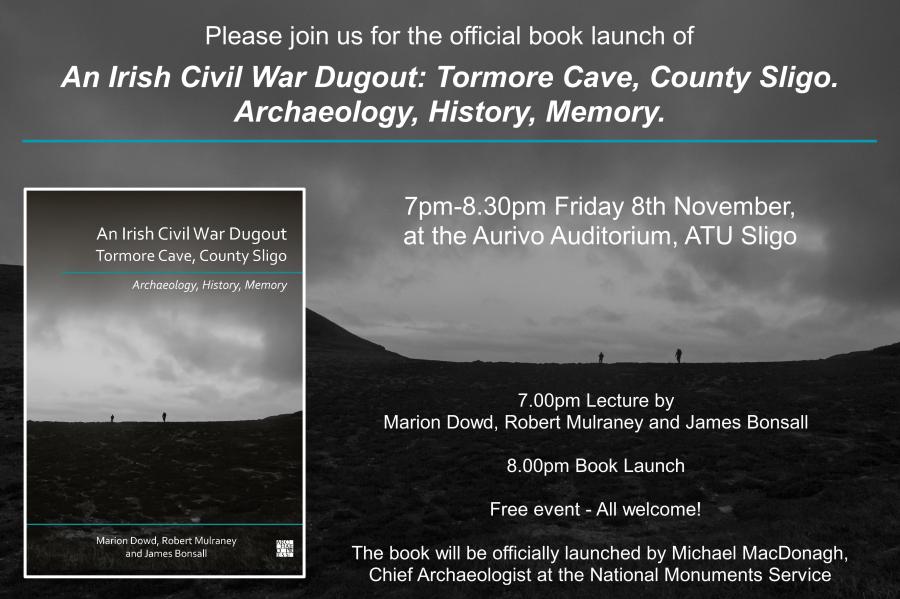
It is almost three years to date when we first visited Tormore Cave, on the back of cherished family memories of the site. It is more than 70 years since Father William Pilkington last visited the cave which had a profound influence on his life. It is also 102 years since Pilkington, as General Officer Commanding of the 3rd Western Division IRA, sought refuge there, along with more than 30 men, for six weeks.

Their retreat was a desperate one in which the new, confident, and uncompromising Free State National Army drove the last stand of Sligo Republicans into the hills and plains of the Dartry mountains. In doing so, they isolated six republicans, likely making their way to the cave hideout, on the slopes of Benbulbin. The men were disarmed and, defenceless, were cut to shreds with Lewis machine gun fire (‘The Six‘). Thirty other Republicans escaped into Tormore Cave, a dugout prepared for the most desperate of events – like those which occurred on September 20th, 1922.
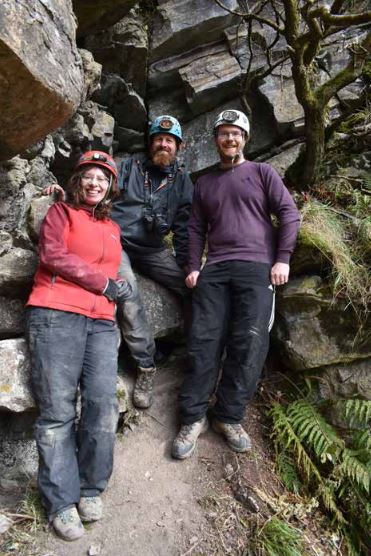
When we – three archaeologists – arrived in late 2021, little was known about the cave, save that retained in local and familial memory. Six months later we conducted a cave excavation (under license of Dr. Marion Dowd, co-author). Two further years later, combining primary and secondary sources as diverse as lithic analysis, zooarchaeology, geological consultancy, military and media archives – published and unpublished, interviews with family descendants and untranscribed diaries and recordings, we can now present a most exhaustive analysis of these otherwise forgotten events.

Our work in its final form is unique – a detailed analysis of what some historians might consider a ‘non-event’, that is, a brief period of reclusive silence at the periphery of the main events of civil war. The protagonists of the story, men and women who were generally not to be remembered, are at the fore. A further man, Fr. William Pilkington, who played a vital role, nationally, at the close of the Civil War, would have been remembered were it not for his intentional self-removal from the story. His first biography is given here. Another unique aspect and a first, is the cave excavation itself – the first Civil War site and, dugout site, to be excavated in Ireland.

There are many strands to this book and it is made for a multitude of interests. Reflecting this, and the fact that we are ultimately at the debt of the community who safeguarded their story, and allowed us to tell it, the publication will be available to freely download, upon the book’s launch.
Re-launch of Caves of Ireland website!

I am pleased to present a newly reworked and improved version on my website Caves of Ireland! The site, which initially started as a personal blog in 2014, quickly developed and, despite a period of recent silence, continues to attract large numbers. With over fifty thousand views and almost twenty thousand visitors, and a growing photographic archive, I have decided it’s time to re-lauch it.

Many hours of work have gone into making this possible. Every single photo, of which there are about 300, was re-stamped, resized and very many were re-edited. All of the text has been revised, and many old items removed and new ones added. New entries are being worked on at present.

The most immediate change that will be noticed is the overall appearance of the site. For this I am extremely grateful to Becks Kelly who, in large, redesigned the entire site. Her work has given it a neat consistency, a greater ease-of-read and a really smart look.

Oweynagat: The Cave of Cats, Roscommon

These photos are from a trip to Oweynagat Cave in County Roscommon last summer. It is somewhat a different theme from usual as this cave is of much archaeological and folkloric significance. I hope you enjoy!

Click here to go to the page

Barton’s Hole, County Sligo

My latest entry, Barton’s Hole, is an anomaly for being both a cave and a mine. Read the article here! Enjoy!

A Selection of Recent Photos

It’s been a while since I made any updates but I have not been inactive, all the opposite I have visited a large number of caves over July and August and thus taken on a few more projects! The following photos come from such caves, hopefully I will have more to show soon.

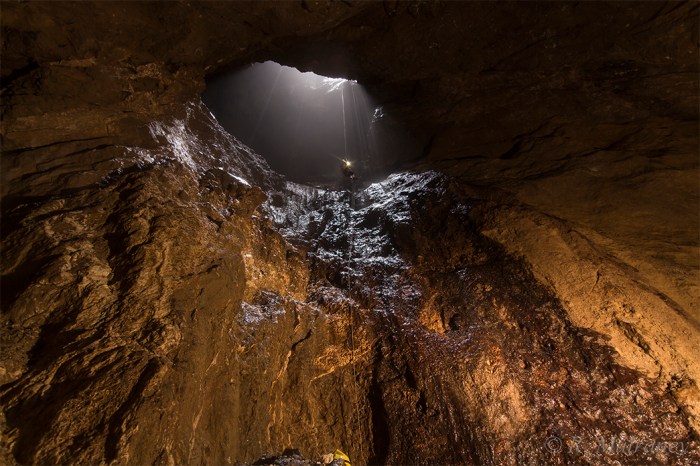
Peter Bryant’s Bullock Hole. Unfortunately I had some epic gear failure here (as well as in Cascades) so I was unable to light up the massive chamber to the extent I wanted. However, my flashbulb guns are being operated upon and I hope to return soon and finish the job:

Peter Bryant’s Bullock Hole

A flying visit to Pollnagossan produced this photo, of which I am quite pleased. I have updated the page also:

Trench Hall, Pollnagossan

I have also added a new entry for Pigeon Pot and updated Boho. Other caves visited such Cascades and Peter Bryant’s Bullock Hole will have to wait to get their own entries until I have more to show!

Pigeon Pot

_MG_0006145

Boho Cave

I have numerous photos of Cascades Rising from two trips but I will create a page for it only when I take more photos that do justice to it’s final and beautiful stretch:

Cascades final

Carrickbeg Rising, County Fermanagh

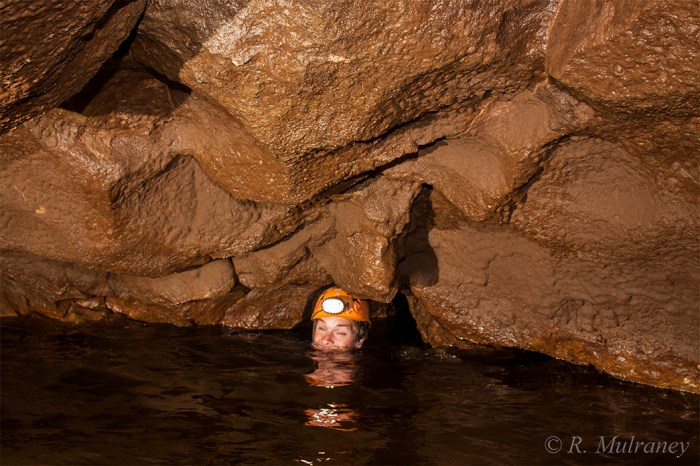
It being summer and all, another wet cave was knocked off the list, this time Carrickbeg Rising in County Fermanagh. Only a few pics to show from this short cave as I did not feel like getting my camera too wet nor did I like asking cavers to pose while threading water 🙂

Nice cave, nice company, nice day day out

Follow the link: Carrickbeg Rising

New Discoveries in North Leitrim

This weekend a joint effort by Shannon Group, Breifne Caving Club and Queens University Caving Club led to the discovery of a new 50 meter pitch on Largy in North Leitrim. The fantastic new pitch, found after a short dig through a gravel choked crawl, leads into a large chamber shared by a neighbouring pothole, Pollrunda and makes for and excellent through trip.

Click here to read the article and see photos from the trip

A Swim in Arch Cave, Co. Fermanagh.

I have added a new page of photos from a trip to Arch Cave in County Fermanagh.

Follow the link here to see the article

Beginnings…

I have always enjoyed taking photos and continue to take my camera with me most places I go. When I started caving it seemed natural to take my camera into caves as well, where I soon found it difficult to get decent photos. My first shots were on a manual compact camera using it’s built-in flash and displayed the typical cave photo scenario ‐ lots of black spaces, bad focus and, most frustratingly, air moisture filling the entire frame. A good example of one of my very first cave photos follows, and this is of the ones I chose not to delete!:

Pollnagollum (Of The Boats), November 2012. Taken on Canon Powershot with inbuilt flash.

I have made improvements by taking more lighting equipment underground, using a DSLR camera and transporting it all in waterproof boxes. Nearly all the gear I use for cave photography is second hand and bought cheap. Taking better cave photos does require familiarisation with certain technical aspects associated with flash photography, but for the most part it is relatively straight forward and the biggest difficulties are met in lugging gear around underground and cleaning it all after the trip!

Pollnagollum (Of The Boats), June 2014. Taken on Canon 450D with one flashbulb and one off‐camera electronic flash.

More photos from Pollnagollum (Of the Boats) can be seen here.